

Shaumpishuh Statue Committee Call For Artists
Remembrance, Respect, Reconciliation
We seek to honor with a statue a woman whose key role in the founding of Guilford and Madison Connecticut is little known. Shaumpishuh was the Quinnipiac sachem (chief) of the Mennunkatuck Band of the Quinnipiac People who for thousands of years lived on the lands that became Guilford and Madison. In 1638 and 1639 Shaumpishuh negotiated agreements with English Colonists as a leader of her people; she fought for the rights of all Quinnipiac throughout her life. Our planned statue will stand in the center of Guilford facing the historic Green as a symbol of remembrance, respect, and reconciliation for the Quinnipiac People and her role in the original history of Guilford, Madison, and the Shoreline Region of Connecticut.
A Biography of Shaumpishuh is below.
Who was Shaumpishuh?
Shaumpishuh was the sachem of the Mennunkhtuck Band of the Quinnipiac People (Guilford and Madison, Connecticut) when the English colonists arrived along the Shoreline of Connecticut in 1638 following the end of the 1636-38 Pequot War. Because she was an adult at the time and died prior to 1683, one can assume she was in her twenties or early thirties at the time of the arrival of colonists in 1638.
Shaumpishuh was the sister of the Quinnipiac Grand Sachem, Momauguin who’s principle village was Mioonkhtuck (East Haven/New Haven) and niece of Qussuckquansh, sachem of the Totoket Band (Branford). This indicates she was part of an elite family with a tradition of leadership.
Shaumpishuh played a leading role in negotiating the arrival and settlement of the Puritan English colonists when they sailed into New Haven Harbor in 1638 with the purpose of establishing a settlement there. The New Haven Agreement was written down by the English and translated to the Quinnipiac by an Englishman, Thomas Stanton. The agreement to share the land around the harbor was “signed” by Momauguin and his counselors including Shaumpishuh.
That agreement clearly records that Shaumpishuh spoke up for the benefit of the Quinnipiac stating that in return for agreeing to share the land around the harbor, the English would protect them from their enemies and provide trade goods. In 1639, when a second group of colonists arrived, she negotiated with their leadership under the Reverend Henry Whitfield. The agreement stated that in return for the English settling where her village of Mennunkhtuck was located, she would move with her band to their land across the Kuttawo (East) River in what is now Madison. There were few restrictions on Quinnipiac movement throughout the area by the English and the Quinnipiac continued to move freely through what they considered shared land.
Shaumpishuh’s name is not present on the written agreement with Whitfield but identified as the Squaw Sachem and is identified the same way, though first, in a list of names of the Mennunkhtuck men only followed by her uncle, Qussuckquansh, the Sachem at Totoket (Branford Ct.).
In 1641, Shaumpishuh’s Band abandoned their village along the Kuttawo due to pressure from the Mohegan Sachem Uncas. Her band dispersed to join their people at Totoket and Mioonkhtuck but records show they continued to move in and out of their original territory including what would become North Guilford.
Upon her arrival at Mioonkhtuck, Shaumpishuh continued for the rest of her life to be one of the chief negotiators with the English colonists on a wide variety of disagreements and issues as well as new agreements, especially following the death of her brother. It is interesting to note that even though the culture of the colonists did not recognize or allow rights to women, Shaumpishuh throughout her life spoke for her people as an equal to the Puritan English men and not as a subordinate.
The colonists however in writing the “treaties”, seldom mentioned her by name but instead referred to her as the Squaw Sachem or Sachem Squaw possibly indicating their probable discomfort negotiating with a woman. As time went on however, Shaumpishuh is referred to as the Sunk Squaw or Sunksquaw meaning Elevated Woman in the Quinnipiac language. She is named, however, in later New Haven Colony documents. As Shaumpishuh aged, some of her roles among the Quinnipiac were assumed by her daughter Shambisqua and son Nausup.
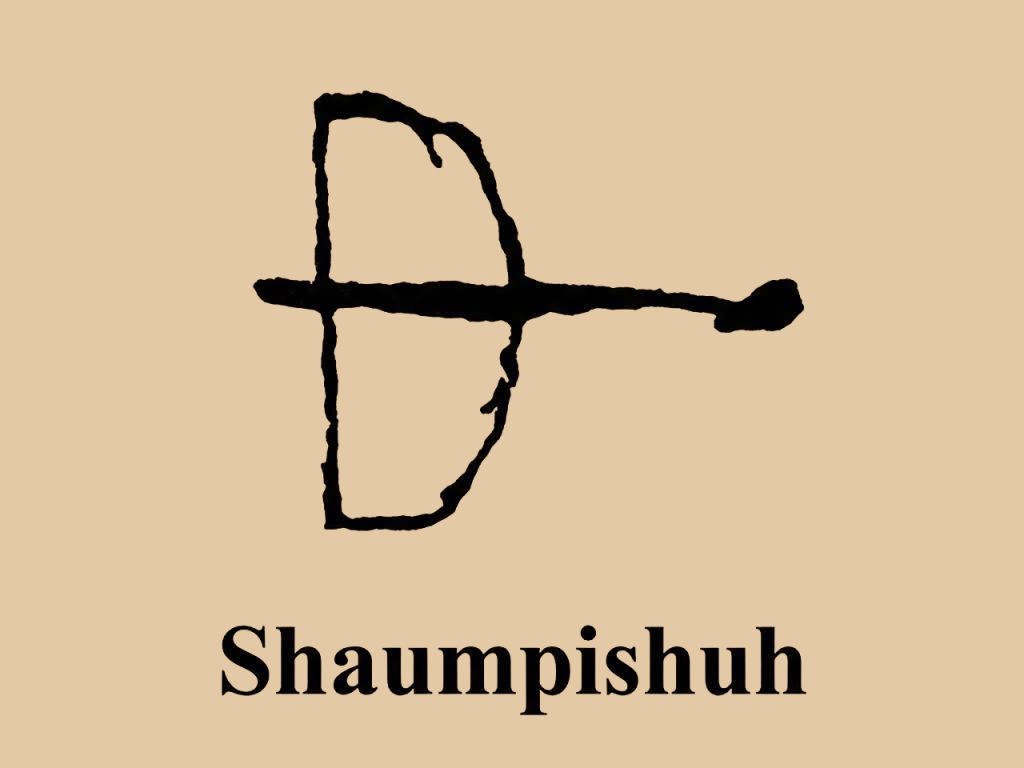
What information we have about Shaumpishuh’s appearance comes from a few English records. She was probably taller and larger than the average English woman and most men. It is easy to assume that based upon her lineage and position among the Quinnipiac, Shaumpishuh must have had a rather regal dignity that compelled even the English leaders to treat her with respect. In signing agreements with the colonists by “making her mark”, she utilized two of the most powerful Indigenous symbols, a bow and arrow and a pipe, signs of temporal and spiritual authority.
Locally, in Guilford Connecticut, a committee has been formed to have a statue of Shaumpishuh placed in the area facing the historic Guilford Green which was once the planting ground of the Mennunkhtuck Band that she led. Working with the Guilford Board of Selectmen, a site has been chosen and efforts are now beginning to solicit proposals of a statue from sculptors and raise funds for its creation and maintenance. The Shaumpishuh Statue Project is a 501(c)(3) and donations can be currently mailed to “Shaumpishuh Statue”, PO Box 406, Guilford CT 06437. You can also contact us at Shaumpishuh.committee@gmail.com for more information.
Why a statue of Shaumpishuh?
- During a time of tremendous and catastrophic social, economic, and cultural change that threatened the Quinnipiac way of life, her leadership for fifty years helped the surviving Quinnipiac navigate unimaginable changes.
- The history of the 17th Century New Haven Colony and the entire Shoreline region of Connecticut might well have been different if not for Shaumpishuh.
- The Connecticut towns of Guilford and Madison would not exist where they are if Shaumpishuh had not negotiated with the Puritan colonists led by Henry Whitfield.
Why honor Shaumpishuh?
- To honor and recognize that she fought for the rights of her Quinnipiac People throughout her life.
- She sought to live in peace with the English colonists while protecting the rights of the Quinnipiac in a rapidly changing world.
- She represents the Quinnipiac People, who for thousands of years occupied the Shoreline and the important role they played in the region.
- She represents all Indigenous People past, present, and future.
- Shaumpishuh is a role model as an enlightened leader and individual for everyone; men, women, and children.